News
From the MSc Artificial Intelligence for Business Transformation to Adobe: Jeffrey Lima’s Journey
You’ve followed a fairly hybrid path. How did you get into artificial intelligence?
I joined the Master in Management (PGE) program after preparatory classes. I started in Lille, where I spent a year and a half, then went to Brazil before continuing my studies in Paris. I then chose the MSc Artificial Intelligence for Business Transformation, a joint degree offered by SKEMA and ESIEA.
Above all, the program gave me a dual skill set, both technical and managerial.
At Adobe, I need to be able to understand a client’s IT architecture and ecosystem, as well as their marketing and business challenges.
I learned to code, primarily in Python, and to build machine learning systems, AI agents, and orchestration systems. At the same time, I learned how to understand business challenges and manage artificial intelligence projects.
Today, I work on Adobe solutions involving artificial intelligence, among other areas.
Do you use this combination of technical and business skills in your work today?
Absolutely. At Adobe, I need to be able to understand a client’s IT architecture and ecosystem, as well as their marketing and business challenges. Part of my role is to bridge these two worlds: understand the client’s needs and translate them for IT teams. Today, I work on Adobe solutions involving artificial intelligence, among other areas.
The program also taught me something essential: how to keep learning.
We work on public speaking, technological innovation, management, as well as a culture of feedback and active listening.
AI technology is evolving so quickly that you constantly have to keep your knowledge up to date. That intellectual agility is definitely one of the key things I took away from the program.
After your final internship, you joined Adobe’s Graduate Program. What does it involve?
At Adobe, the Graduate Program is a permanent position for junior professionals who have already completed an internship with the company. The goal is to develop skills and take on greater responsibility very quickly.
We work on public speaking, technological innovation, management, as well as a culture of feedback and active listening. Since I work in presales, the latter is particularly important: you need to understand the client’s needs, translate them into a technical solution, and support the client throughout the process.
Skesia grew out of an experience with your younger brother. How did that personal story become a real educational project?
At the time, my younger brother was 11 and was really struggling with math. I tried to help him with his homework, but I found it very difficult to get certain concepts across to him. At the same time, I would watch him play Roblox and effortlessly master mechanics that could sometimes be quite complex.
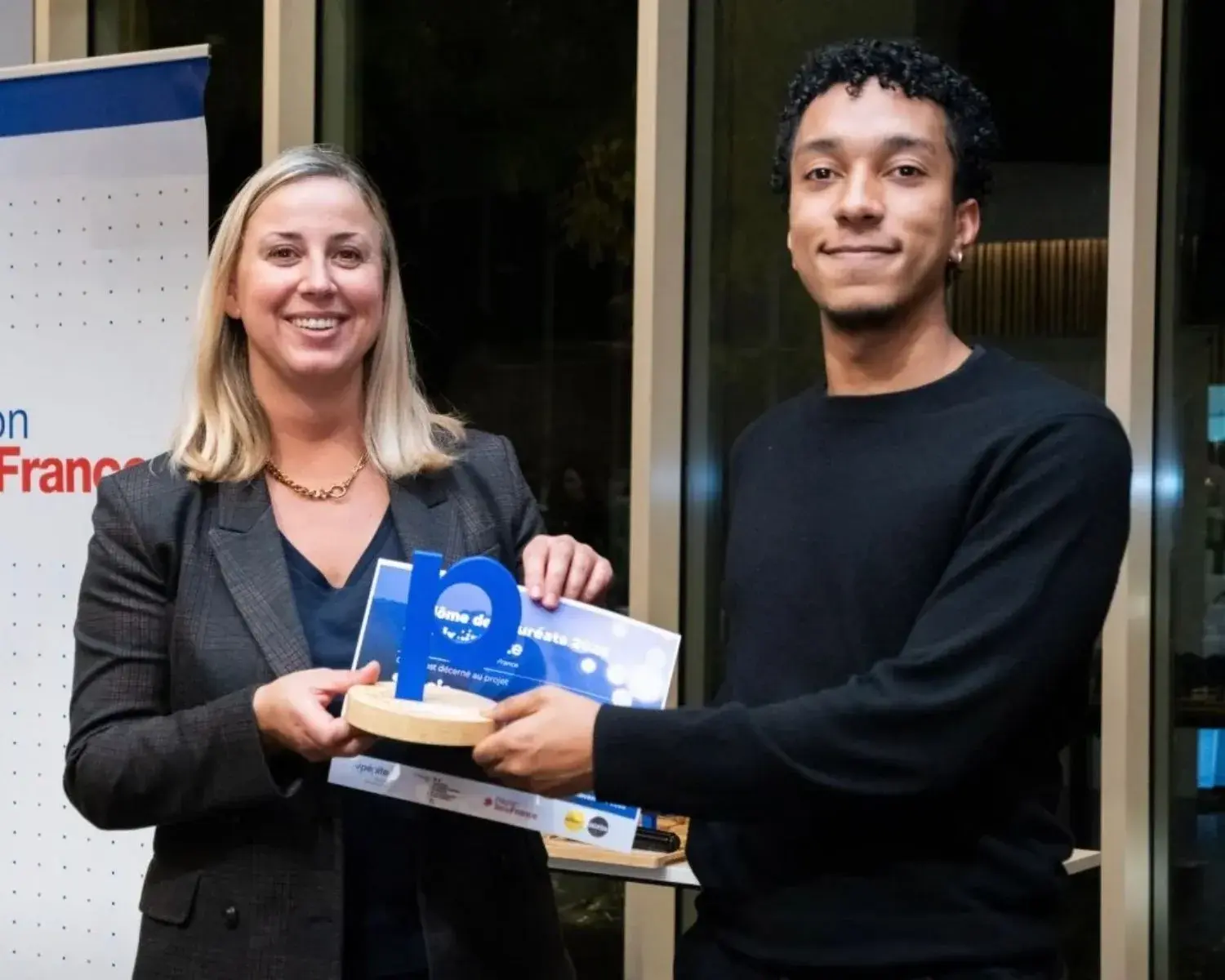
That got me thinking: when something is gamified, what seems complex can suddenly become much easier. So, together with Alexia, Mohamed, Sara, and Jason, we came up with the idea of creating a real video game for learning math. Our first prototype, developed during a Google hackathon, finished in second place.
Gradually, the project grew beyond that initial personal experience. We began testing the game with other students and in several middle schools, following a continuous improvement approach: students play, we collect their feedback, and we use it to improve the product.
What did you learn from those initial tests with middle school students?
The response was very encouraging. Even students who struggled with math enjoyed practicing mental math, multiplication, addition, and division.
With support from Henri Sellier and Émile Zola middle schools in Suresnes, among others, we were able to run multiple rounds of testing and improvement. Two interns from a gaming school also helped develop a more advanced 3D version, inspired in part by the world of Roblox.
Ultimately, the best sign is when students stop asking when class will be over and start asking when they can play again.
How far do you want to take Skesia?
For now, Skesia is focused on middle school students. Eventually, we would also like to reach elementary school students and then high school students.
Math lends itself particularly well to games: you solve a problem, move forward, earn a reward... Ultimately, math is made to be gamified!
What role does artificial intelligence play in that ambition?
The goal is to make learning more personalized. Every student can approach a problem differently or encounter different difficulties. The AI agent therefore needs to be able to support students when they get stuck, whether by explaining a concept again, giving them a hint, or temporarily suggesting an easier exercise before returning to the original problem.
Our philosophy is to understand how each student thinks so we can adapt their learning journey accordingly. That is precisely where artificial intelligence opens up so many possibilities.
Your time in Brazil has also had a rather unexpected impact on your work at Adobe...
Yes. During my exchange in Belo Horizonte, I learned Portuguese. Today, that skill is directly useful in my work at Adobe: I also work with the Portuguese market, I can present solutions to clients in Portugal, and I have also had the opportunity to work in Brazil.
It’s very tangible: a skill I acquired during my study abroad experience became a real professional asset a few years later.